Welcome to the Urban Ecology and Conservation Lab at UMass Boston
We integrate approaches in the natural and social sciences towards the conservation of biodiversity in a rapidly urbanizing world.

Use the navigation bar on the left to learn more about the lab.
LAB NEWS
10/15/2026: Congrats to Zakary Purcell on his poster presentation at the 17th annual Student Conference on Conservation Science held at the American Museum of Natural History in New York City (SCCS-NY 2026)! Zakary’s poster was titled “Impacts of Urbanization on Biocultural Diversity in Costa Rica’s Pacific Coast” and is a product of our emerging biocultural research in Costa Rica’s rapidly changing coastal communities.
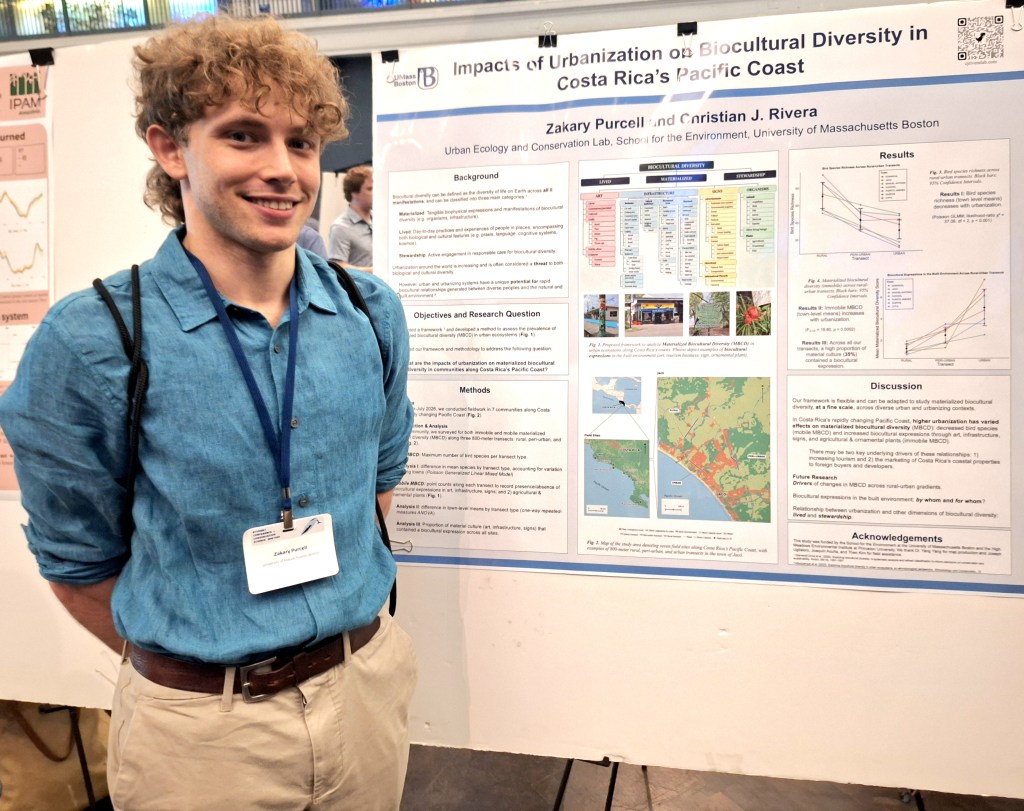
09/2026: We are happy to welcome three new members to the lab! Undergraduate student Zakary Purcell joined in January 2026 and graduate students Marina Marquis and Jeremy Green joined in September. Read more about Zakary, Marina, and Jeremy in the Lab Members page!
07/2026: A new study, “Tourism, Human-Wildlife Interactions, and Wildlife Trade in the Globalizing Amazon“, was published in Conservation Science and Practice. This study was co-authored by three former undergraduate research assistants who worked with me in Iquitos, Peru, during summer 2024. Other co-authors include researchers at Princeton University and local collaborators in Peru. Blending approaches in conservation science and anthropology, we provide one of the first comprehensive attempts to understand tourism activities involving wildlife in the urbanizing Peruvian Amazon. Some of these activities are potentially detrimental to conservation and include photos/selfies with animals; handling, feeding, and playing with wildlife; wild meat consumption; and live animal trade.
06/2026: Our perspective piece titled “Toward more inclusive governance and conservation in the urbanizing Amazon” was published in the journal Conservation Science and Practice. We argue that by integrating place-based and flow-based perspectives, more inclusive and trust-based governance can better support sustainable resource use and biodiversity conservation across the rural-urban interface of the Amazon.
3/13/2026: Our new paper, “Teaching the Wildlife Trade: A Social-Ecological Systems Approach“, was published in the Journal of Environmental Studies and Sciences. This article is a report of a course I developed and taught at Princeton University and which I plan to teach at UMass Boston’s School for the Environment in the future. The wildlife trade is a “wicked” problem. Understanding it calls for applying the tools of systems thinking and drawing from diverse disciplines including conservation biology, criminology, and anthropology. The article was co-authored by four of the former undergraduate students in the class. Their contributions resulted in key insights that would have been overlooked if presented solely by the instructor!
1/20/2026: Congrats to Marquez C. White (Ecology & Evolutionary Biology, Princeton University ’24) on his paper “Factors influencing survival of rescued Amazonian manatees (Trichechus inunguis) during clinical rehabilitation in Peru“, published in the journal Conservation Science and Practice! This research is part of a collaboration with our local partners at the Amazon Rescue Center (CREA – Centro de Rescate Amazónico) in Iquitos, Peru. This study is the first to characterize factors associated with survival during the clinical phase of rehabilitation for imperiled Amazonian manatees at a wildlife rescue center.
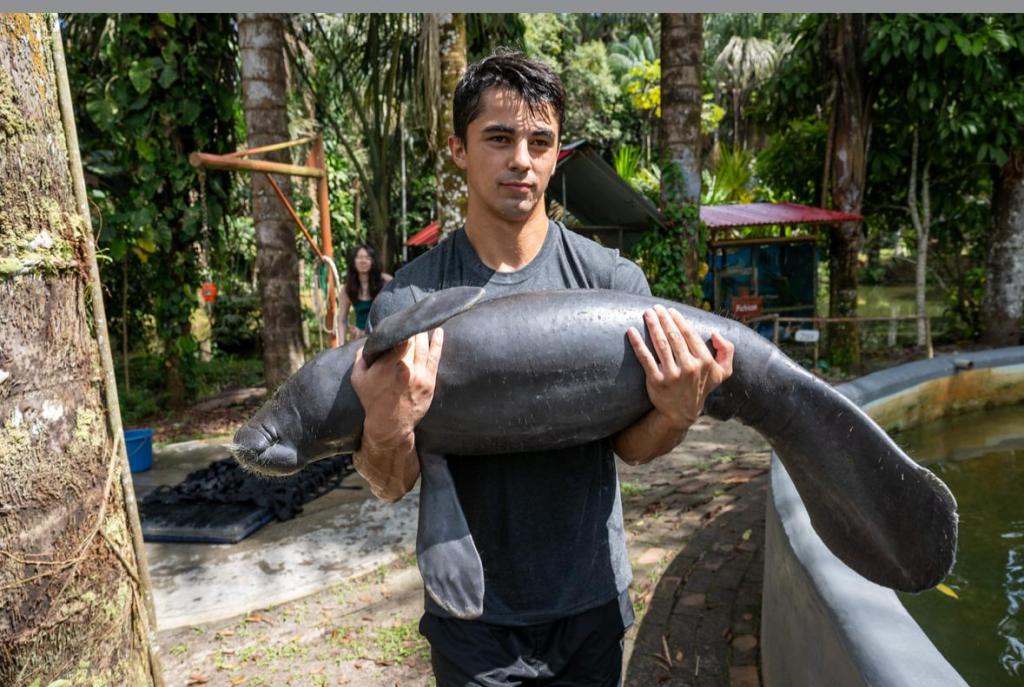
12/7/25: Our new paper titled “A Framework to Analyze Primate Species Vulnerability to Trade in Urban Markets” was published in the American Journal of Primatology, the leading journal in the field of primatology. In this paper, we integrate concepts in primatology and conservation criminology to develop a framework that relates primate characteristics to supply- and demand-side variables. This tool is both explanatory and predictive and can be used to better understand why certain species of primates may be observed in urban markets over others. Check out the open-access paper here!
9/1/25: After three years as an Environmental Research and Teaching Fellow at Princeton University’s High Meadows Environmental Institute, Christian Rivera starts a new position as a tenure-track Assistant Professor in the School for the Environment at the University of Massachusetts Boston.

